System Diagram¶
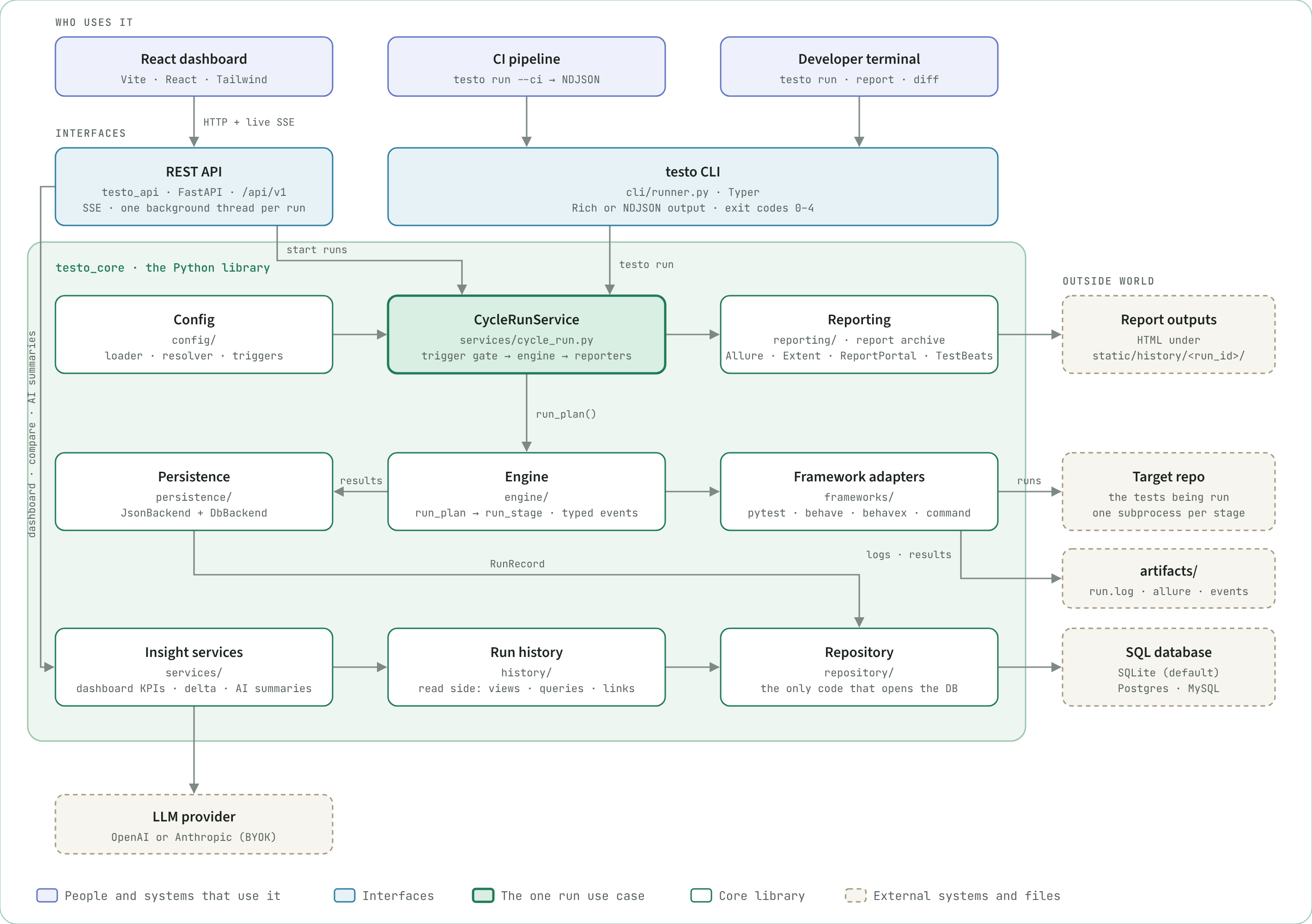
The picture of Testosterone, with what each box does. For module-level detail see Architecture Overview; for the run lifecycle step by step see Deep Dive - Execution Logic.
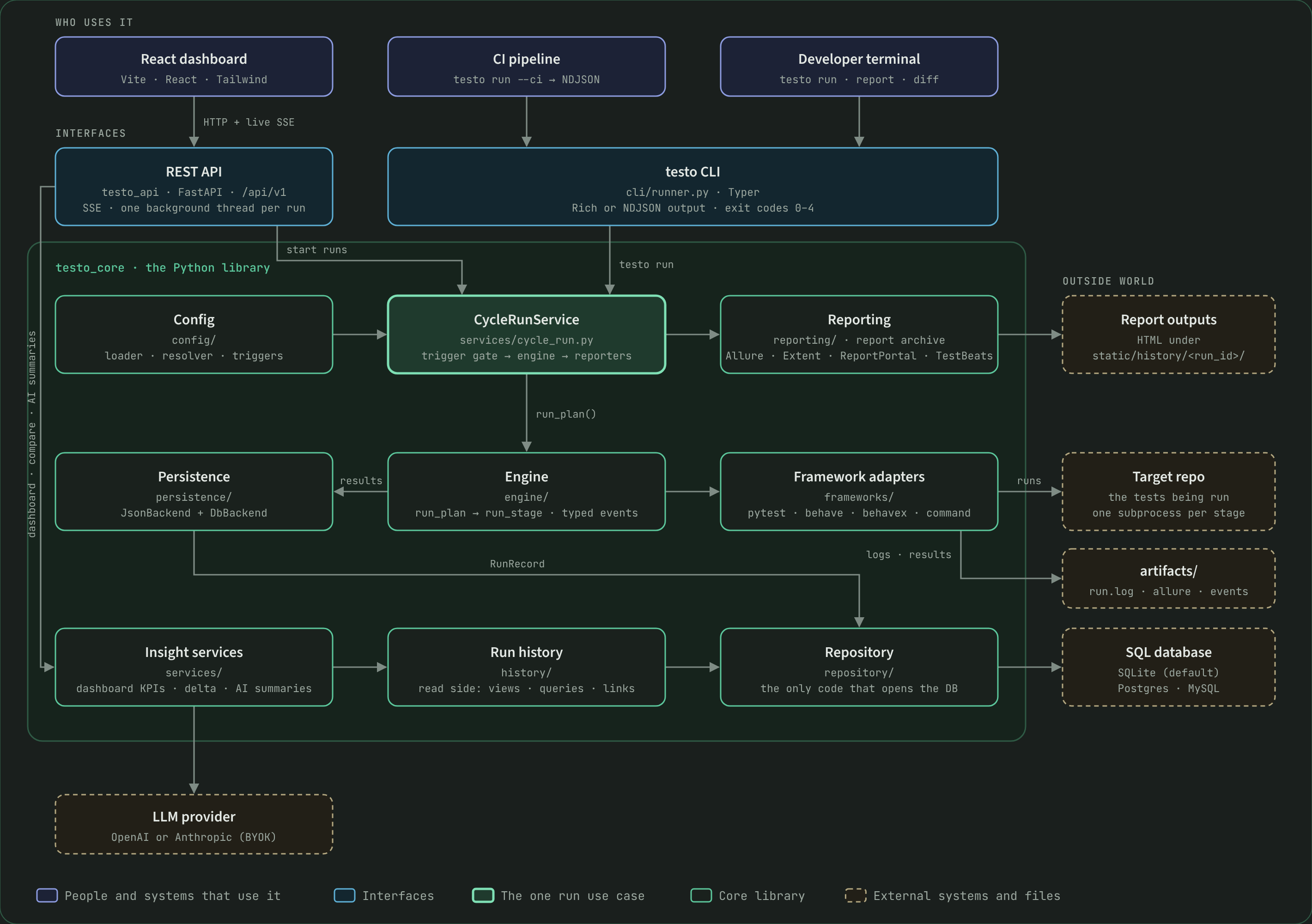
A light copy is testosterone-architecture-detailed-light.png; the README picks between the two by colour scheme. Both are drawn by scripts/render_architecture_diagram.js: change the diagram there and re-run it, never edit the PNGs by hand.
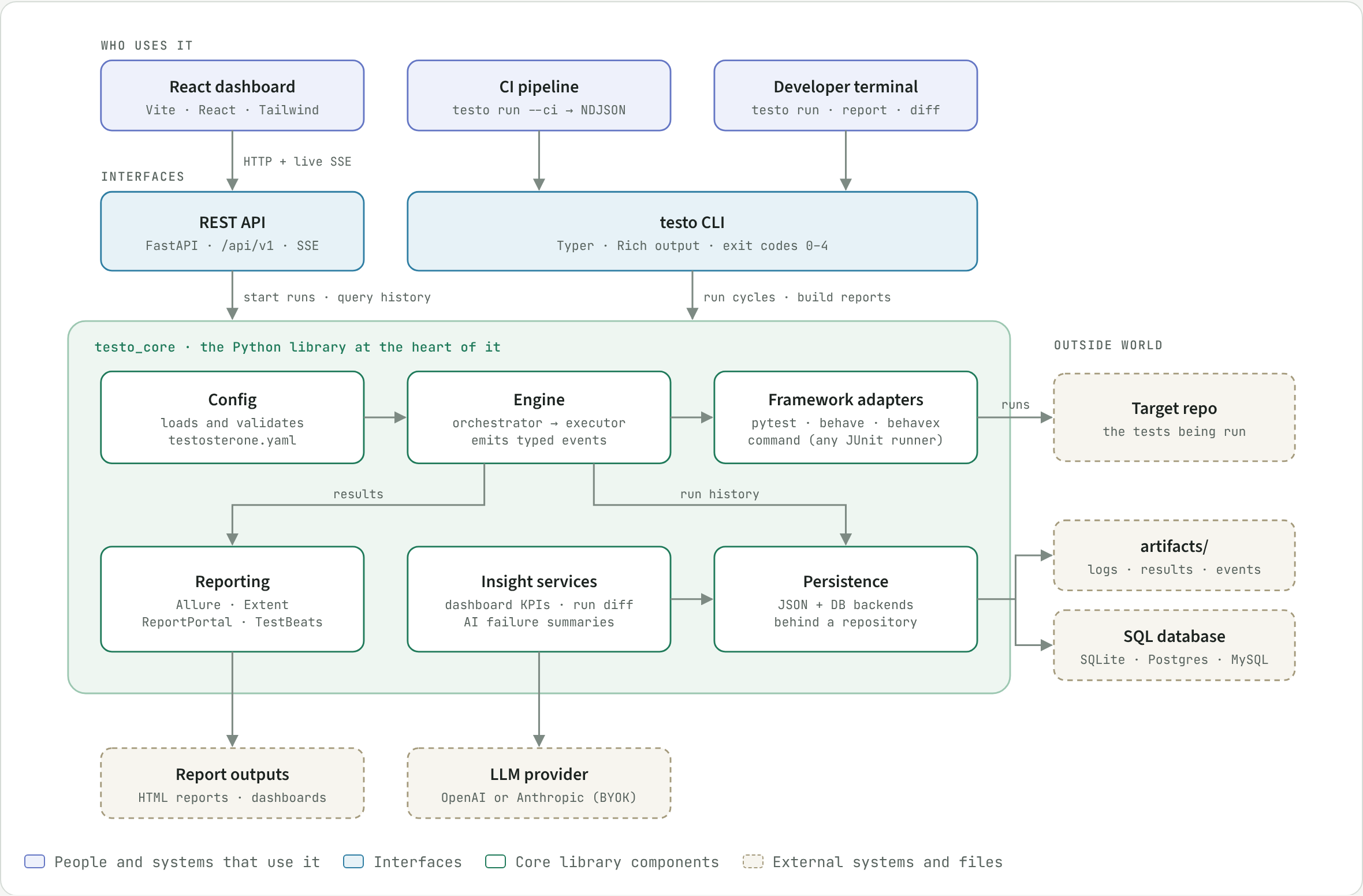
Simplified view¶
The first, six-box version from 2026-10-06. It predates CycleRunService and the history/ read side, so use it only when you need the shortest possible picture.
All diagrams in the vault¶
| Diagram | Shows | Where |
|---|---|---|
| Detailed diagram (image above) | Who uses it, interfaces, CycleRunService, every testo_core package, outside systems |
This note |
| Simplified diagram | The same at six boxes, without CycleRunService or history/ |
This note § Simplified view |
| Component flowchart (Mermaid) | Entry points, CycleRunService, engine, persistence, history read side |
Architecture Overview § High-level shape |
| Run sequence (Mermaid) | One testo run call from CLI to executor and back |
Deep Dive - Execution Logic |
| Cycle flow (Mermaid) | Load, trigger gate, stages, reporters, archive | QA Strategies |
| Demo pipeline (text) | Pages demo: run on itself and fake-api, export to JSON, build, publish | GitLab Pages Demo |
Mermaid blocks render on GitHub, in the GitHub wiki and in Obsidian without plugins.
What each part does¶
Who uses it¶
| Part | Role |
|---|---|
| React dashboard | Starts cycles, watches them live, browses past runs, compares two runs |
| CI pipeline | Runs testo run --ci: NDJSON events on stdout, pass or fail through the exit code |
| Developer terminal | Runs cycles locally with Rich output, opens reports, diffs runs |
Interfaces¶
| Part | Role |
|---|---|
| REST API | FastAPI under /api/v1 (testo_api/). Starts cycle and ad-hoc executions in the background, streams progress over SSE, serves dashboard, history, compare and AI summary data |
| testo CLI | Typer app (testo_core/cli/). Commands load lazily so testo --help stays fast. Exit codes 0–4 are a fixed contract (Command Reference § Exit codes) |
Both interfaces start runs the same way: through CycleRunService (testo_core/services/cycle_run.py), which applies the trigger gate, calls the engine, then runs reporters, metrics push and the report archive. It is the highlighted box in the detailed diagram; the simplified view folds it into the arrow into testo_core.
Core library (testo_core)¶
| Part | Package | Role |
|---|---|---|
| Config | config/ |
Finds and validates testosterone.yaml, fills defaults and ${env:…}, resolves a cycle into ordered stages |
| Engine | engine/ |
run_plan() runs stages in order; run_stage() runs each as a subprocess with a timeout and a tee'd log; every step is a typed event |
| Framework adapters | frameworks/ |
Turn a stage into argv for pytest, behave, behavex, Playwright or command (any runner with JUnit XML) |
| Reporting | reporting/ |
Collects Allure results and builds Allure, Extent, ReportPortal or TestBeats output; run KPIs and their push |
| CycleRunService | services/cycle_run.py |
The one run use case: trigger gate, engine, reporters, metrics push, report archive |
| Persistence | persistence/ |
Writes plan_result.json (JSON backend) and a RunRecord row (DB backend) after each run |
| Insight services | services/ |
Dashboard KPIs, run-to-run delta, AI failure summaries; called by the REST API |
| Run history | history/ |
The read side: typed views, queries, report links and snapshot files over stored runs |
| Repository | repository/ |
The only code that opens a database session (SQLite, Postgres or MySQL) |
Outside world¶
| Part | Role |
|---|---|
| Target repo | The project whose tests run; each stage runs inside it |
artifacts/ |
Per cycle and stage: run.log, Allure results, events.ndjson, plan_result.json |
| SQL database | Run history that feeds the dashboard and Compare |
| Report outputs | HTML reports under static/history/<run_id>/, or results pushed to ReportPortal / TestBeats |
| LLM provider | OpenAI or Anthropic with the user's own key, only when AI summaries are on |
Design choices the picture encodes¶
- Config is the contract. The developer, CI and the dashboard run the same cycle from the same file.
- Events, not callbacks. The engine only emits events; renderers (Rich, NDJSON, SSE) decide presentation.
- Small interfaces at the seams. Framework adapters, persistence backends, the repository, reporters and AI providers are swappable.
- One result format. Every framework's output becomes Allure results, so every report and comparison works for every framework.
- Light by default. Database, API and UI dependencies are optional extras.
The reasoning behind the current shape (one engine, one history boundary, generated frontend types) is in Architecture Consolidation - 2026-10-06.